“I want to improve my swimming for triathlons.”

As triathlons are becoming more popular, they’re also becoming more competitive. Unless you swam in college, chances are your swimming form could use work. “No pain, no gain,” may be an effective philosophy when it comes to training for the bike and run, but not for swimming. Doing a “long swim” to train your aerobic capacity will only reinforce bad habits and keep you slow. Swimming with poor technique can exhaust your body and is bad preparation for the bike and run.

Newbie Triathletes

Many of our new triathletes come from running and cycling backgrounds.  Even those who took lessons as a child find that they forgot everything that they learned and they are now flailing down the pool.  You are right when you think that if you run a marathon, you should be in good enough shape to swim 50 yards without having a heart attack.  But it's not about fitness or being in "shape."  It's about technical efficiency, comfort, and basic aquatic awareness.

If you have never had formal instruction or had it a long time ago, we suggest that you start with our Adult Learn to Swim Level 2 or Level 3 classes.  Even if you can do some freestyle, these classes will teach you the fundamental aquatic skills that lie behind the strokes -- breathing, floating, navigation, sculling, kicking, and treading/deep water comfort.  New swimmers often want to skip these steps because they "just need to get through a mile;" these are often the same swimmers who come to us wondering why they are tense and short of breath.  After meeting the Level 3 proficiency through classes or lessons, we suggest that you move onto the mainline Freestyle clinic track:  Freestyle 1, Freestyle 2, and Freestyle 3.

As you learn these new skills, you'll need a place to practice them.  We suggest using the "Technique and Aerobic Development" practices on our Masters Team to build your swimming skills and fitness.  The group environment  and on-deck coaching will keep you honest, get you used to swimming with other people, and make swimming more fun as you meet other people.      

Intermediate Triathletes

Most intermediate triathletes come to us to improve their Freestyle to go faster or to go longer; the Freestyle 1 clinic is our mainline clinic and the recommended starting point for 90% of our triathletes.  We will work on improving the economy of your stroke and teach you how to think about your practice to maximize the effectiveness of your pool time -- something that will easily get squeezed as you train in three disciplines.  Our Freestyle 2 and Freestyle 3 classes will build off the foundations of Freestyle 1 and teach you to move with more grace, speed, and power.

In addition to tweaking your stroke we recommend you train with our Masters Team. We hold 12 practices a week—each with a different theme (stroke technique, aerobic development, IM workout)—to train well rounded and complete swimmers. The practices will add structure to your training and will push you more than you will swimming alone.  Also consider learning the other strokes to make yourself more versitile at race time.  Our advanced learn to swim classes will teach you the other strokes, starts, and turns to help your swimming "cross-training" and to improve your aquatic sex appeal.

Experienced Triathletes

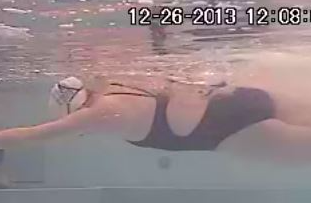
If you have competed in many triathlons or have finished high in your age group in spite of your swimming split, we can help you figure out the key elements of your stroke or training to get you to your bike faster and on less energy.  We recommend you start with a Swim Assessment, a one-on-one 75 minute session at the Blue Dolphins Swim Studio where you and a member of the coaching staff will assess your current technique, speed and training. The session includes under and above water video taping, race and training analysis and goal setting. The Swim Assessment will help you break down your individual issues and create a plan to correct them (which may include private lessons, group training, etc) in time for your A-races. Along with your plan you’ll leave with a DVD: We trim your video clips and add annotations to help you remember what to work on when you leave the Swim Studio (for a sample Swim Assessment, click here).  Depending on your skill level, you can proceed with private lessons or classes to complete the Freestyle 1, Freestyle 2, or Freestyle 3 sequences.

Because you are looking to improve your finish, we suggest that you train with our Masters Team. We hold 12 practices a week—each with a different theme (stroke technique, aerobic development, IM workout)—to train well rounded and complete swimmers.  You can swim daily with some of the best Masters swimmers in the state, the nation, and the world.  Each practice will force you to elevate your game and learn to swim as effectively as smart as those who have been swimming their whole lives.  By swimming with the big dogs, you'll be better prepared to swim at the front of the pack in your races.

The goal of this sequence is first to get you moving through the water with less resistance and effort and then move through the water with more speed and propulsive force.  For those of you coming to us for Total Immersion instruction, see the Freestyle 1, Freestyle 2, and Freestyle 3 class descriptions to see how we present that material to you.

Your track is (click on any class for a more detailed description and registration):

To a T, we’ve found that triathletes who make their swim faster and more efficient also improve their over all race times: if you leave the water less exhausted and stressed you’ll have more energy to bike harder and run faster. We’ve taught hundreds of triathletes using this method, including Hans, a triathlete. Hans joined CBD struggling to complete longer distances and fighting through the water with his legs dropped at a 40-degree angle. Hans took our Freestyle 1 clinic, diligently practiced his stroke drills, and swam with our Masters Team 3 days a week. He was able to complete his swim at Ironman Louisville in 1:22 – without a wetsuit. Since then he has focused on Sprints, Olympics, and Half-Ironman races including the Rockman Sprint, Accenture Olympic, and the Wildflower Half-Ironman. His racing goals for 2009 are continued speed improvements in his swims and overall times in Sprint and Olympic distances. We’ve also taught him the other strokes, and he plans to swim the butterfly and individual medley events at the 2009 Illinois Masters State Meet with the big dogs.